Trusted to deliver where complexity matters












Automotive organisations operate in one of the most complex, fast-moving industries. Multiple interconnected systems across manufacturing, supply chain, product development, dealer networks, and increasingly software and connected services create significant dependencies. Changes in one area ripple through others. Legacy infrastructure sits alongside cutting-edge requirements. And the pressure to innovate, across electrification, autonomous driving, software-defined vehicles, and new business models, is relentless.
Emphasys has delivered complex transformations and modernisation work in automotive environments. We understand the sector: the complexity of managing high-dependency systems, the tension between innovation speed and quality control, and the need to move from activity to outcomes by aligning business needs, architecture, engineering, and delivery. Our automotive digital transformation work focuses on reducing delivery friction, improving visibility, and helping organisations modernise without losing control of quality or governance.
Automotive organisations typically face a consistent set of challenges.
Product development depends on manufacturing capability. Software depends on hardware design. Connected services depend on infrastructure. A delay in one area cascades through others, and a decision in one team affects multiple others.
Legacy and innovation coexist. Automotive organisations are still running systems and processes built around traditional vehicle manufacturing while simultaneously developing electric vehicles, autonomous systems, and connected services. The old and new need to work together, and you can’t remove legacy systems while they’re still supporting vehicles that generate revenue.
Automotive is a regulated industry with quality standards and safety requirements that can’t be compromised, yet strict control can slow innovation. Too much and you fall behind competitors. Too little and you introduce quality and safety risks. Multiple suppliers and teams add further complexity. Coordinating change across internal teams, external suppliers, and complex governance structures is difficult. Clarity can get lost, decisions can conflict, and programmes can stall waiting for alignment.
We address these challenges by improving delivery clarity and reducing friction. We help organisations move from activity to outcomes, improving efficiency, reducing time-to-market, and strengthening quality. We help align business needs, architecture, engineering, and delivery so everything flows together.
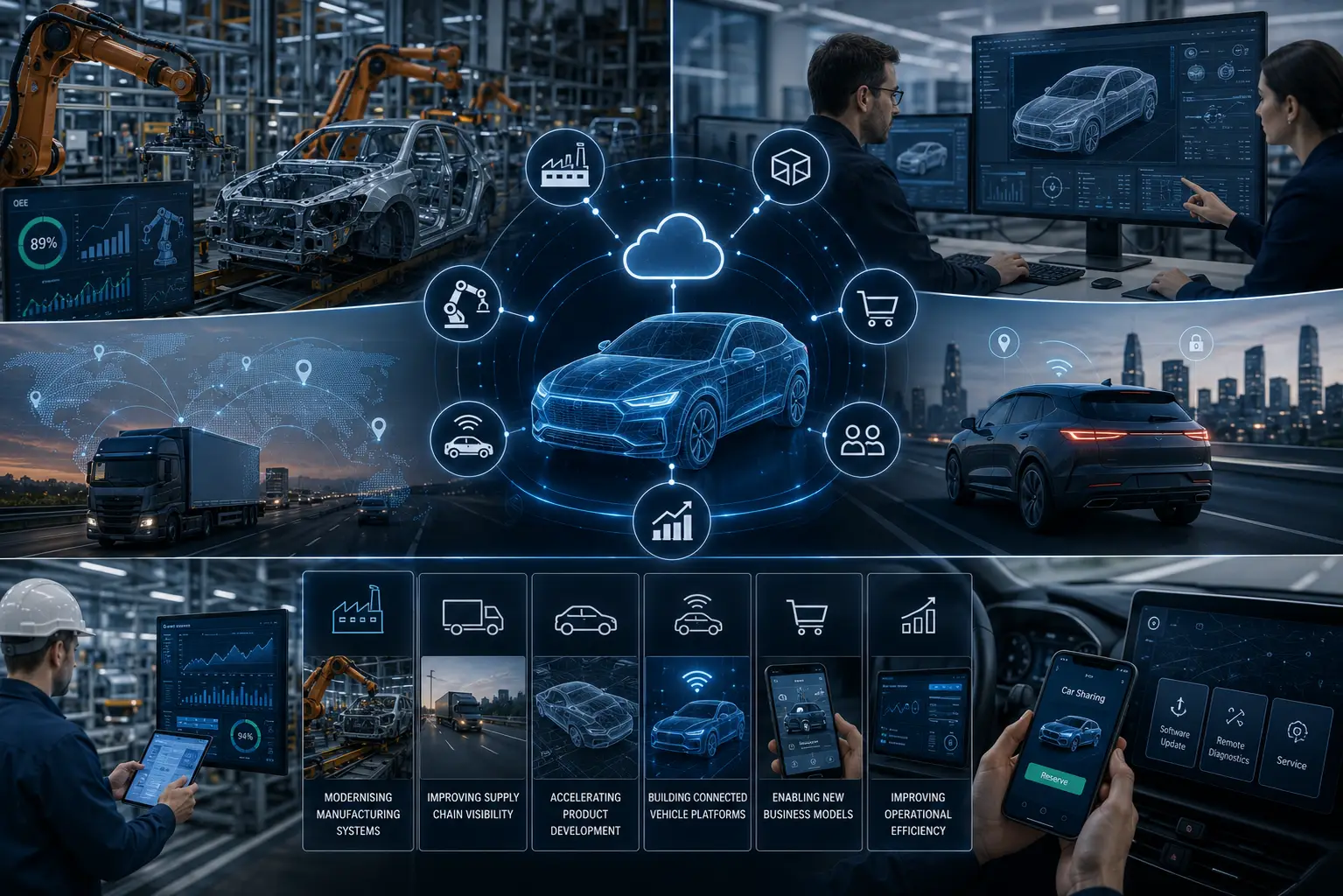
Automotive digital transformation covers a wide range: modernising manufacturing systems, improving supply chain visibility, accelerating product development, building connected vehicle platforms, enabling new business models, and improving operational efficiency.
Our work starts by understanding what outcomes you’re trying to achieve. Reduce time-to-market? Improve manufacturing efficiency? Build connected services? Reduce operational cost? Improve quality? Once the outcomes are clear, we identify what needs to change: process, technology, organisation, or a combination. This prevents spending on initiatives that sound compelling but don’t deliver business impact, and helps prioritise which changes deliver the most value so you can sequence work to build momentum early.

Cloud, data, automation, and platform engineering all fit naturally into automotive transformation, but they need to connect back to measurable business outcomes rather than exist as isolated technical capabilities.
Cloud modernisation supports faster deployment and iteration, reduces operational overhead, and creates the foundation for connected services and data analytics, but only when it’s designed around specific business needs. Data platforms create visibility across complex operations, connecting manufacturing, supply chain, product development, and customer data to support better decisions and enable predictive maintenance and supply chain optimisation, but only when the data is accessible, trustworthy, and built around the decisions that matter.
Automation reduces manual toil and improves consistency across manufacturing, workflow, and process tasks, but only when it’s applied to processes that genuinely benefit from it. Platform engineering gives teams the infrastructure and standardised patterns to move faster without creating chaos, but only when those platforms reflect how teams actually work.
We help automotive organisations bring these capabilities together as part of a coherent transformation strategy rather than a series of disconnected technology projects.
Automotive quality standards and safety requirements are non-negotiable, but you also need to move quickly. Maintaining control and quality while reducing delivery friction requires governance that enables rather than obstructs.
We embed quality and governance into delivery from the start. Clear standards prevent problems downstream. Continuous visibility means issues are caught early. Sound architecture means systems work together reliably. And clear governance means decisions are made without unnecessary delay. When teams understand what good looks like, they build it right the first time. When systems are well-architected, integration is smooth. When governance enables delivery rather than blocking it, teams move faster with confidence.

Automotive organisations can’t afford to halt production while transformation takes place. Legacy systems need to keep working while new capabilities are built. Old and new need to coexist during the transition.
We sequence changes pragmatically so production continues, manage dependencies carefully so changes don’t create cascading failures, and validate that new systems work before cutting over from old ones. We build hybrid environments where legacy and modern systems operate together during the transition period. This matters in automotive because downtime affects revenue and reputation. A production stoppage is expensive. A quality issue creates recalls. A delivery miss affects customer commitments. We carry out automotive transformation with the rigour the industry demands.
Coordinating change across multiple internal teams and external suppliers is inherently complex. We help coordinate across those parties, integrate with existing partnerships without creating conflict or duplication, and bring clarity to complex programmes so alignment happens despite the complexity. We supplement your internal capability, provide specialist expertise where needed, and stay accountable for outcomes end-to-end rather than just for our piece of the work.
If your automotive digital transformation programme is already underway and something isn’t working, we can help. Programmes stall for consistent reasons: the real problem wasn’t understood from the start, scope isn’t clear, teams aren’t aligned, or complexity has accumulated without anyone owning the outcome end-to-end.
We help by clarifying the real problem, resetting scope where needed, and reducing unnecessary complexity. We ask difficult questions, but constructively and always as a partner focused on getting the programme back on track.
Whether you’re modernising manufacturing systems, building connected vehicle platforms, improving supply chain visibility, reducing time-to-market, or resetting a programme that’s stalled, let’s talk about moving from activity to outcomes with clarity, control, and delivery quality. Get in touch with our Automotive team.