Why Digital Transformation Fails

Up to 70% of digital transformations fail. In our experience, this is rarely because organisations do not care, or because the technology is inherently incapable. It is far more often because the work is framed too loosely, governed too weakly, measured too poorly, and asked to carry more ambition than the organisation is ready to absorb.Transformation done well is not about moving faster. It is about moving with clarity, discipline, and purpose.
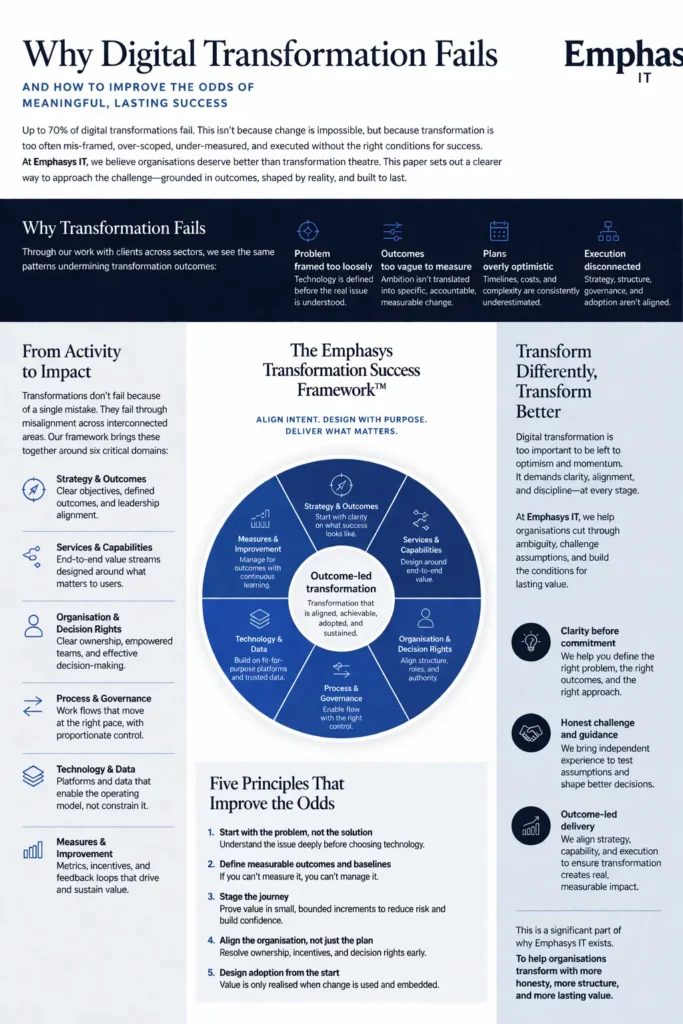
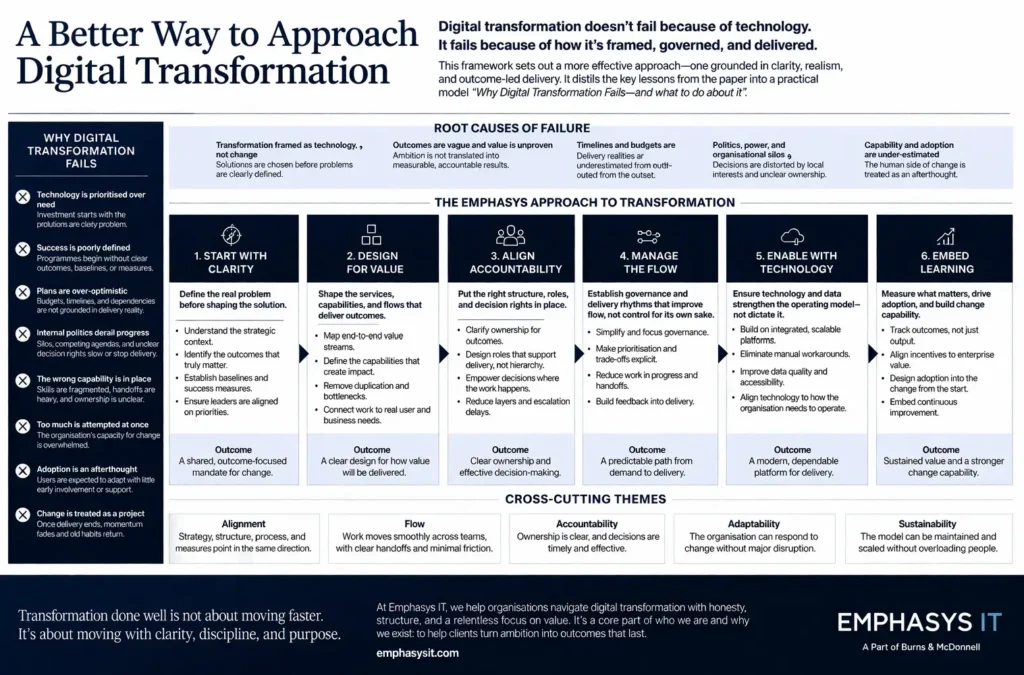
Figure 1. A practical model for understanding why digital transformation fails and what better looks like.
Executive Summary
Digital transformation is one of the most important and most consistently misunderstood challenges facing organisations today. It is frequently positioned as a people, process and technology problem (how many times have you heard that), when in reality it is a problem of organisational clarity, operating discipline, and sustained change capability.
At Emphasys IT, we believe organisations deserve better than transformation theatre. They deserve sharper problem definition, more honest planning, stronger alignment between strategy and delivery, and a clearer route from investment to measurable value.
This paper sets out our view that transformation failure is rarely random. It usually emerges from recurring and recognisable conditions: vague outcomes, unrealistic timing and budgets, internal politics, fragmented capability, excessive concurrency, weak adoption planning, and a tendency to treat transformation as a temporary project rather than an enduring capability.
Those patterns matter to us because helping organisations avoid them is a significant part of why Emphasys IT exists. Our role is not simply to accelerate activity. It is to help clients make better decisions, shape more credible paths, and create outcomes that last.
| Key message | Digital transformation usually fails not because ambition is wrong, but because the work is framed, governed, sequenced, and adopted poorly. |
1. Why this matters
Digital transformation now sits at the centre of strategy for many organisations. It shapes investment decisions across customer experience, service design, cloud, data, artificial intelligence, operational resilience, cyber security and more. Yet the language of transformation often runs ahead of the organisation’s actual readiness to deliver it.
That gap between ambition and readiness is where many failures begin. Organisations launch large programmes, mobilise teams, acquire tooling, and create momentum before they have answered more fundamental questions. What specific problem is being solved? What outcomes matter most? What constraints will shape delivery? What evidence will be used to prove that the change created value? What will we not do?
For Emphasys IT, this matters deeply because poor transformation has real-world consequences. It wastes money, absorbs leadership attention, frustrates teams, damages confidence, and too often leaves organisations believing that change itself is the problem, or people are the problem, or maybe the technology wasn’t as good as we thought. In our view, the problem is usually none of the above, they are all symptoms of change that hasn’t been understood and structured.
2. The central argument
The central argument of this paper is that digital transformation fails in patterned ways. Failure is rarely the result of a single dramatic mistake. It is more commonly the result of several understandable but compounding weaknesses: technology selected before the problem is properly defined, outcomes that are too vague to measure, plans built on optimism rather than evidence, governance distorted by politics, and delivery models that do not match the complexity of the work.
Seen in this way, transformation failure should not be treated as a mystery. It should be treated as an organisational design issue. That distinction is important because it shifts the response from trying harder within the same flawed model to redesigning the conditions that make success possible.
3. Where transformation starts to fail
One of the earliest and most common errors is to frame transformation primarily as a technology intervention. Cloud, automation, integration, AI, or a replacement platform may all be valid components of a solution, but they are not meaningful outcomes in themselves. Where the solution is chosen too early, the organisation starts implementing before it has properly understood the issue to be resolved.
That creates predictable downstream effects. Benefits become loosely attached to the existence of the technology rather than to measurable changes in performance. Teams are expected to move quickly while questions of process, ownership, incentives, user behaviour, and adoption remain unresolved. Activity grows, but value remains difficult to prove.
4. The recurring causes of failure
First, outcomes are often too vague. Programmes begin with ambitions such as becoming more agile, modernising the estate, improving customer experience, or becoming data-led. Those ambitions are directionally useful, but analytically weak unless translated into explicit outcomes, baselines, target conditions, and accountable owners.
Second, timelines and budgets are regularly optimistic from the outset. Delivery plans are shaped by what feels acceptable to approve, not by the real complexity of dependencies, decision-making, platform readiness, data quality, and organisational absorption. Once work begins, variance is treated as a surprise when it was in fact embedded from the start.
Third, internal politics constrains progress. Competing budgets, unclear ownership, local incentives, and compromise-led governance can distort what should be outcome-based decisions. Technically sound plans still fail where the organisation has not aligned decision rights and accountability.
Fourth, capability is often fragmented. Strategy, architecture, engineering, delivery, service design, and adoption are separated into silos and connected through hand-offs. The issue is not always lack of talent; it is more often the wrong shape of capability needed for cross-functional change.
Fifth, organisations attempt too much at once. Multiple initiatives compete for the same people, the same decisions, and the same capacity for change. Progress becomes measured in starts rather than finishes, and the organisation’s ability to absorb change is overwhelmed.
Finally, adoption is too often treated as an afterthought. Transformation is not complete when technology is deployed… it is complete when changed capability is being used in a way that improves outcomes. If adoption is weak, the transformation remains largely theoretical.
5. What better looks like
In our experience, better transformation begins with clarity before commitment. The problem must be defined before the solution is shaped. Outcomes must be explicit before delivery ramps up. Baselines must exist before benefits are claimed.
It also requires more honest planning. Large ambitions should usually be broken into smaller, bounded stages that allow value to be proven, assumptions to be tested, and learning to shape later phases. Staged delivery is not about thinking small, it is about reducing avoidable risk and improving decision quality.
Better transformation also depends on alignment. Strategy, operating model, governance, capability, technology, and adoption need to point in the same direction. Where they do not, delivery effort is consumed in compensating for systemic misalignment.
Above all, transformation should be approached as a capability, not merely as a project. Modern organisations do not need isolated bursts of change. They need the enduring ability to sense, prioritise, design, deliver, and absorb change repeatedly and responsibly.
6. Why this is significant to Emphasys IT
This topic sits close to the centre of why Emphasys IT exists. We believe professional services firms should do more than accelerate activity or fill resource gaps. They should help organisations understand the real nature of the challenge in front of them, challenge weak assumptions, and shape delivery approaches that are grounded in evidence and value.
We care about this because poor transformation creates long-term cost, technical debt, organisational fatigue, and missed opportunity. We care because public and private sector organisations alike are being asked to navigate increasingly complex forms of change, often under time and budget pressure, and they deserve support that is honest, disciplined, and outcome-led.
A significant part of our purpose is to help clients transform with more clarity, better structure, and more lasting value. That means designing work around outcomes, sequencing change realistically, embedding adoption and user needs from the start, and treating quality as foundational, not optional.
7. Conclusion
Digital transformation fails too often, but it does not fail without pattern. In our view, the most damaging issues are recognisable: weak problem definition, vague measures of success, unrealistic planning, misaligned governance, fragmented capability, overloaded portfolios, and insufficient attention to adoption and learning.
That is precisely why organisations can improve their odds. By addressing those conditions directly, they can replace momentum without direction with change that is disciplined, measurable, and durable.
For Emphasys IT, making a positive difference in this space is not peripheral to what we do. It is a meaningful part of who we are. We want to help organisations move from activity to impact, from assumption to evidence, and from transformation programmes that consume energy to transformation capabilities that create lasting value.
How Emphasys IT can help
Where organisations recognise the symptoms but not yet the root causes, we help by bringing an independent, structured view of the problem space. Our work typically focuses on:
- Clarifying the real problem before investment is locked in
- Defining measurable outcomes, baselines, and value realisation paths
- Diagnosing operating model, governance, capability, and delivery constraints
- Shaping staged, realistic transformation roadmaps
- Embedding adoption, learning, and accountability from the outset
| Emphasys IT exists to help organisations transform with more honesty, more structure, and more lasting value. |