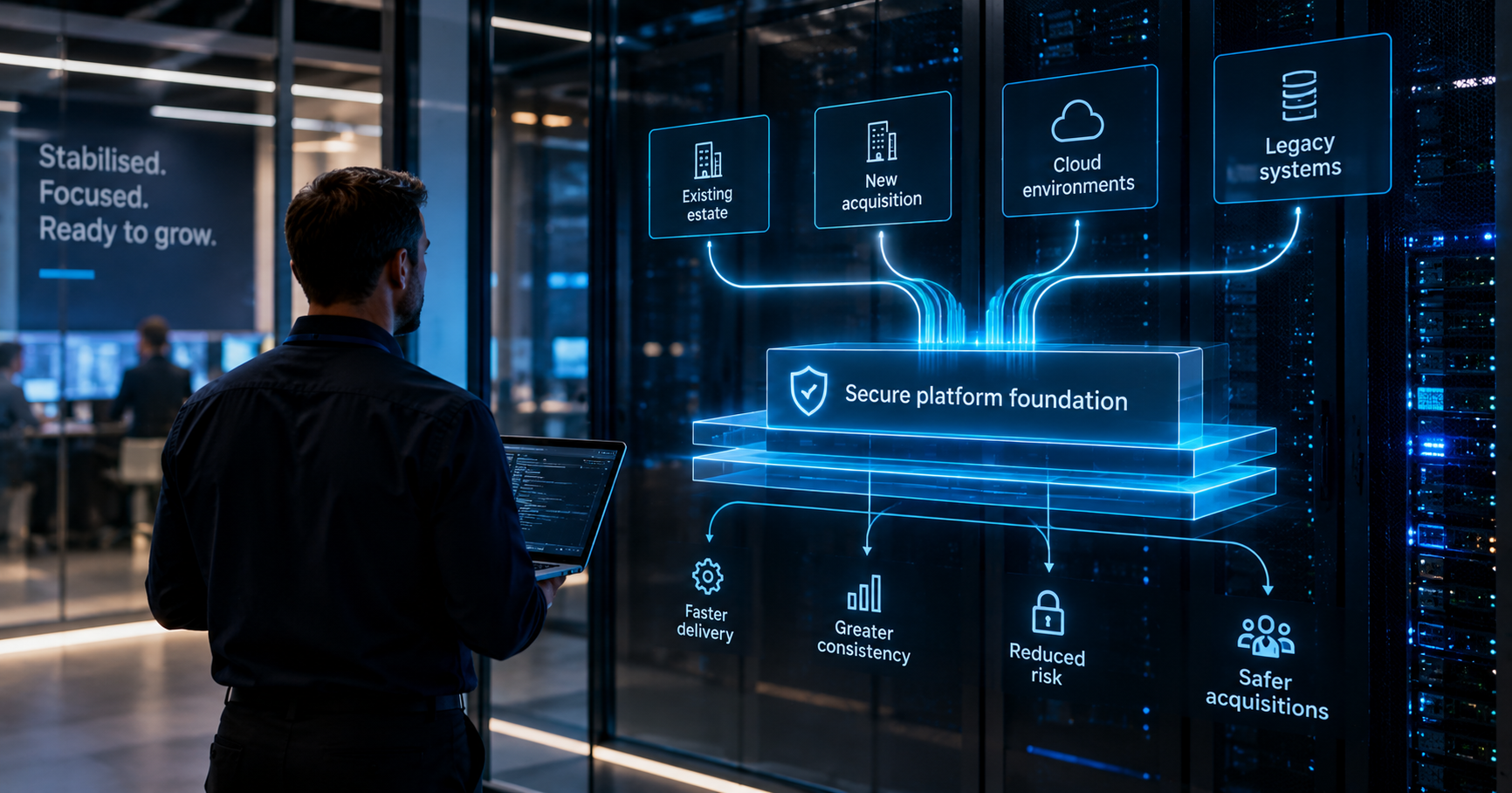
Creating a secure platform foundation for faster delivery and safer acquisitions
Client: Leading retirement and pensions services provider
Sector: Financial Services
Engagement: Cloud landing zone and business platform automation
Emphasys IT contribution: Architecture, Terraform and Azure DevOps automation, security design, implementation leadership, environment standardisation
Executive summary
A financial services organisation wanted to move away from a manual cloud build programme that was slower, less consistent and more exposed to human error. Emphasys IT designed and automated its Azure landing zone and key platforms, creating an automation-led delivery model across 11 environments, 4 platform patterns and 95% of deployment steps. By investing upfront in automation and standard patterns, the client reduced build effort, improved security and governance, and created a standard platform model that could support acquisitions and mergers more safely and at greater speed.
At a glance
- 11 environments delivered
- 4 platform patterns automated
- 95% of deployment steps automated
- 100% pipeline delivery for non-development environments
- 8+ corporate integrations aligned to governance and security
- Reusable, centrally managed IaC module library established
The problem
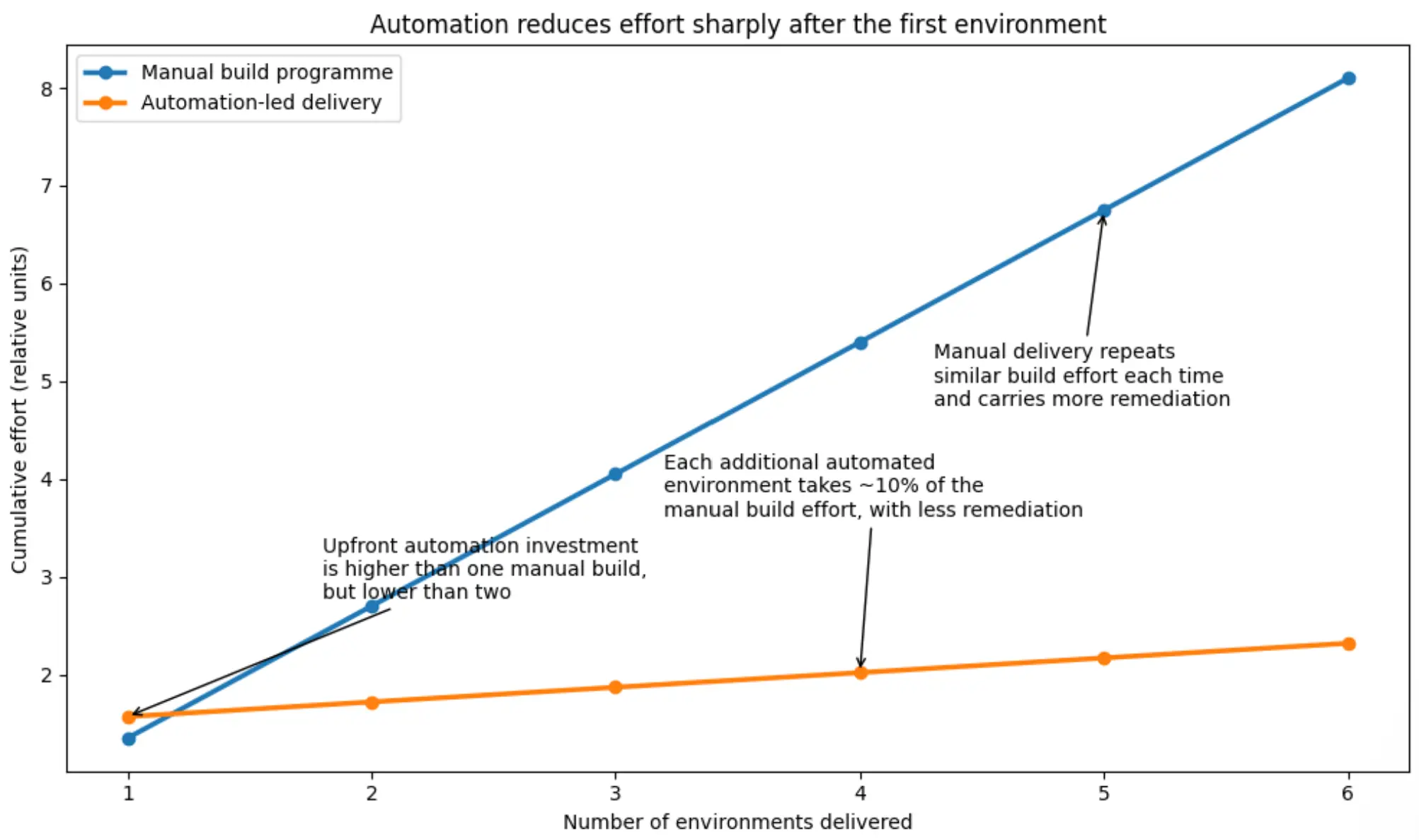
The organisation’s manual build approach was becoming a constraint. Building environments by hand took time, introduced inconsistency and increased the risk of human error, rework and configuration drift. As more services moved into Azure, that model became harder to scale, harder to govern and harder to secure consistently.
The challenge went beyond day-to-day delivery. The business also needed a better way to support acquisitions and mergers. Acquired companies often brought older systems and unresolved security issues. The client needed a standard destination platform for those services, a way to keep them effectively air-gapped from the corporate network while risks were addressed, and a practical route to consolidate them onto secure, governed corporate platforms over time.
The solution
Emphasys IT designed and automated the client’s Azure foundation around a hub-and-spoke landing zone with controlled routing, segmentation, secure breakout and central security boundaries. On top of that, we automated four core platform areas: the Azure landing zone and network foundation, a data processing platform, a Pega business process platform and an Azure Virtual Desktop access platform.
We also created a reusable Infrastructure as Code module library so new environment definitions could be assembled far more quickly than writing everything from scratch. The modules were battle-tested, version-controlled and centrally managed, improving both speed and standardisation across the business.
The delivery model used Terraform, Azure DevOps pipelines, controlled state management and reusable software libraries to make builds repeatable and auditable. It also aligned to existing corporate governance and security standards through integration with a broader control stack.
The outcome
The client moved from manual builds to an automation-led delivery capability across 11 environments and 4 platform patterns. Around 95% of deployment steps were automated, with the remaining 5% reflecting dependencies on global teams whose operating processes required wider change. All non-development environments were delivered 100% through pipelines with no click-ops.
The result was greater consistency, far lower effort for each additional environment, reduced remediation, clearer auditability and stronger alignment to corporate security and governance standards. Around 8 corporate integrations were also built into the solution to support enterprise security, access and operational controls.
The benefit
The biggest benefit was not simply faster builds. It was that the client gained a reusable platform strategy for growth, integration and control.
Instead of treating each new environment or acquired service as a bespoke exercise, the organisation now had a standard set of landing zones and platform patterns it could reuse. That meant acquired systems could be moved onto known-good platforms more quickly, kept separated from the core corporate network while security issues were remediated, and then consolidated into the strategic estate through a governed migration path.
The programme improved delivery efficiency, reduced post-acquisition technology risk, accelerated integration readiness and improved standardisation across the estate. It gave the client not just a faster way to build, but a safer and more repeatable way to grow.